View the full transcript
Transcribed from the episode audio by AI, so it may contain mistakes.
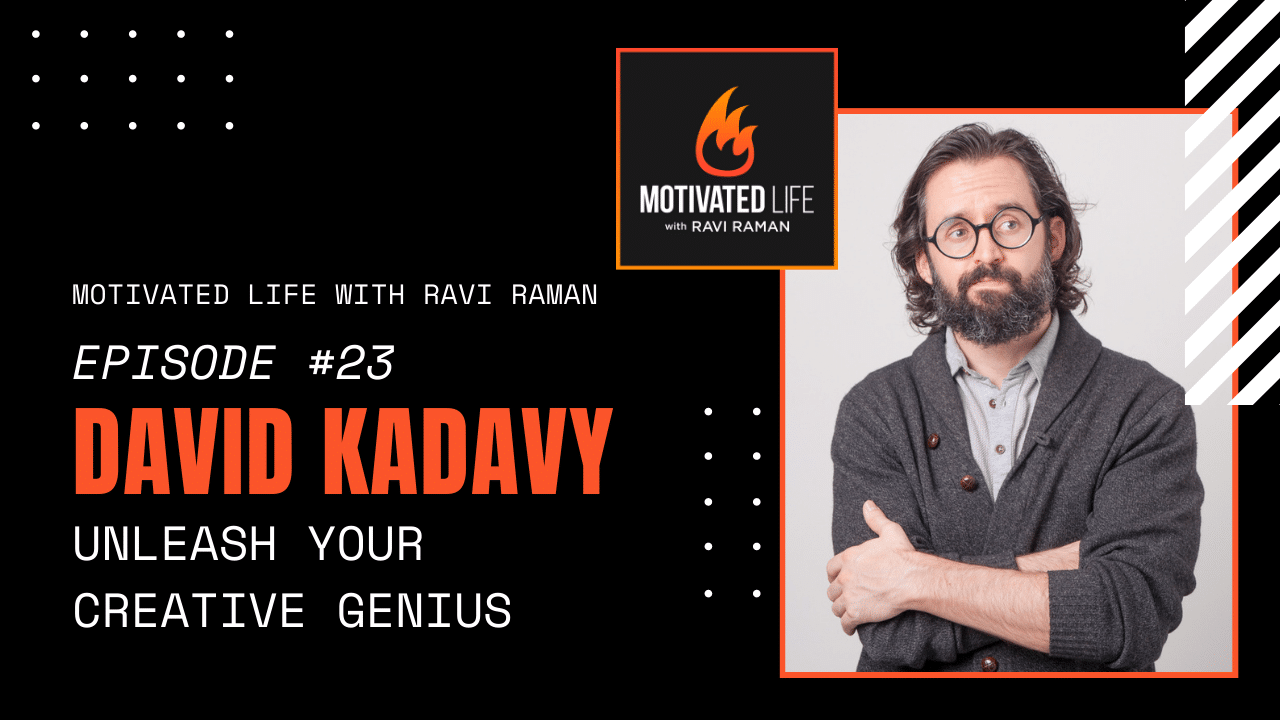
Ravi0:19I'm Ravi Raman. Welcome to the Motivated Life podcast. On today's episode, I bring you David Kadavy. David's someone who I've been following for over 10 years, well over 10 years. Back in the days when blogs were cool, I subscribed to his blog,cadivie.net, and used to read it regularly. I was fascinated by his various interests, his journey into self-publishing, which at the time was relatively, knew, his success in self-publishing, and also his thoughts on psychology, creativity, and lifestyle design. I was also fascinated by his decision to, several years ago, four or five years ago, work from Medellin, Colombia, and be in some ways a digital nomad, but actually just make his home a place that he enjoyed and find a way to make a living from there.
David's a very transparent guy. If you read his blog, he shares his monthly income reports so you can understand how he makes a living and what that's like. And on this podcast we explore a few things. We explore his life journey and the insights that led him to lead what was a promising potential career in Silicon Valley as a designer, having both coding experience and design experience back in the aughts, the mid-2000s, in Silicon Valley. He had a number of potential opportunities to join leading companies at the time, but he decided to take a path less travel.
That, to him, just felt right. And for me, I'm always fascinated by what it is that leads people to follow a calling and take their lives in a direction that is not necessarily the linear or logical path, but is right for them. So we talk about that. We also talk about creativity. David's written several books. They've sold well and they've been self-published. And one of his books, the heart to start, is all about how to be more creative and to bring one's art into the world.
He also has a new book coming up called mind management, not time management. It will be available well, you could pre-order it now, as I have on Amazon, and it will be published just within a few weeks. So by the time many of you listen to this episode, you'll be able to get it, or at least pre-order it on Amazon. So we explore creativity, time management, and what it means for anyone to bring their creativity into the world, whether you are an independent creator, or if you're a middle manager in a tech company, just looking to be more innovative, we discuss how to make that.
happen and why it matters that you make that happen. So I hope you enjoy this episode. Of course, it would mean a lot to me if you would share this episode with people in your network that you think would be benefited by it. And it's always helpful to leave a review wherever you're listening to this episode. It's through your reviews that people are able to discover and find the various interviews and insights that I'm sharing. And with that, I bring you. you, David Cadavie. David, thanks for joining me.
David3:48Ravi, thank you for having me. It's an honor to be here.
Ravi3:52You know, it's not often I thank social media, but I'm going to thank social media. I'm going to thank Twitter right now because, you know, I've been following your work for a long time. You know, I'm losing track of time now, but sometime in the mid-2000s I stumbled upon codavi.net. The aughts. Yeah, the aughts. That's right. Wow. And I said your last name right, Cadavie, Cadavie? Cadavie, yeah. Cadavie, good. So I stumbled upon your blog and I started reading your blog and then you had this book designed for hackers.
I wasn't a designer, but I worked in tech. So I got that. And I thought, oh, this is pretty cool. And then then kept following some of your passive income stuff and then your move, which we'll get into. And so, but then I got back on Twitter recently. And I realized perhaps the most important use of Twitter, which is to actually make real connections. And I started following some of your tweets and some of what you're putting out. And I thought, wow, wouldn't it be great to bring David on and just explore some of the things that you're about that we'll get into creativity and more.
So thank you, Twitter for helping us actually connect. Yes, thank you,
David5:04Twitter. Twitter is really wonderful if you use it the right way.
Ravi5:09Yeah. You know, and your journey, maybe you can paint the arc for me because my memory tells me you're someone who started working in the Midwest, in the heartland, in a cubicle, found your way somehow into Silicon Valley and then took a leap and moved to South America where you've been for a while. It's a pretty interesting journey. Why don't you start by just connecting the dots for us on how you got from point A to Z? Yeah.
David5:37There's an interim in there even. So I did grow up in Nebraska, Omaha, and I never really felt like I fit in there. And it's kind of hard to describe what that was like, you know, pre-internet. You know, you can't even like go see an indie movie, really. I think it's probably you could live in Nebraska now and it would be fine. Like the world is so connected. But that was where I grew up. and I didn't really have good examples around me that confirmed or affirmed the ideas that I had in my head.
I was very curious and I just didn't really feel that that environment supported that necessarily. And so after college, I did end up going and working in a great cubicle for a few years at an architecture firm. And during that time, I decided to start a blog. I was reading all these blogs. I was reading Seth Godin's blog. I was reading various web design blogs. And one day I finally said, yeah, you know, I'm going to do this. And I opened up blogger.com and I started a blog.
You can still see the first post. It's terrible. It's a run on paragraph, It has a misspelling in it And within roughly a year or so, that blog helped me land a job in Silicon Valley, And so I moved out to Silicon Valley, the Bay Area. I worked at startups for a couple years. I spent a year working on my own startup And about 2008 I decided to leave the valley. I came to realize that, while I had learned a lot from the valley about how to believe in my ideas, get that confidence, that I didn't really get growing up in Nebraska and being somebody with strange interests, Um, while I realized that it had helped me with that, I also realized, well, I was paying really high rent for basically access to venture capital and access to talent.
And these were two things I realized I didn't need at all. So I moved to Chicago. Uh, and I rented a two bedroom apartment for the price that I was paying for, uh, one bedroom in an apartment that I was sharing with a bunch of other people in San Francisco. And I really just felt like I had something to offer. I had some ideas in my head. I didn't know what they were, but I wanted to give myself the chance to cut out the noise and to explore what that was.
And after about three years of that, I got an email from a publisher asking me if I'd like to write a book. And I had never... How does that happen?
Ravi8:30Is this just the blog? Is this, were you sort of hustling on the side to make connections and make it happen?
David8:36Well, I had written some blog posts that were popular on the topic of design. Basically, I was trying to get, what I was trying to do was get a talk at South by Southwest. I wanted to go do a talk at South by Southwest. So I engineered this long blog post with a lot of detail in it to try to get votes for my panel and became number one on hacker news, you know, this news aggregator website. and I didn't get the South by Southwest panel, but then I got this email for the book deal, and then by getting that book deal, I did end up doing a talk at South by Southwest.
So yeah, I get this email asking me if I'd like to write a book. And I've, you know, I've been blogging for six years at this point off and on, sporadically. I've written a couple blog posts here and there. There are 2,000 words long or so, but I'm not a writer. I never, that was not a thing that I ever thought of myself as I hate specifically hated writing as a child, you know, growing up in school. I liked to draw. I was an artist. But I did decide to take on the challenge and write this book.
And I did that. The book did very well. Top 20 on all of Amazon. And I started getting flown all over the world to speak. I spoke.
Ravi10:00This is design for hackers.
David10:01Design for hackers. Design for hackers, yes, and I got flown all over the world to speak, spoken eight countries, and in that process I ended up traveling to South America, to Latin America, and I liked the culture a lot. I then just kept coming back during the winters, like after the winter that I spent writing design for hackers, I never spent another winter in Chicago again and eventually I decided, well, I want to do this again. I liked this process of being curious about something, learning a lot about it, trying to teach somebody else about it through writing a book.
I said, well, I want to do that again. I want to double down on this writing thing. How am I going to do that? Well, one thing I wanted to do was reduce my expenses. Another thing was I just happened to noticed during these winter trips that I took to South America, I was looking at the work that I was doing during those trips. And I was like, this is my best writing. I don't know why, but let's go figure it out. So I once again sold everything that I owned, which is what I did when I moved away from Silicon Valley, and moved down here.
And that was about five years ago. And so here I am sitting in Medellin, Colombia, in an apartment with furniture that I own. I did spend four years in a furnished apartment, you know, just to try to clear as many distractions that it could for my life.
Ravi11:46I've seen photos of your desk. I don't know if it's still as sparse as some of the photos you've shared. It's basically a laptop. Yeah, well, the most sparse desk you can imagine. It's a more
David11:57complicated setup now and I actually have, you know, several different setups that I kind of switch between based upon the type of writing or work or thinking that I want to do. And that's part of what I've been doing down here the last several years is really experimenting with how to make creative work happen. Because one of the things I discovered writing that first book was that everything that I had learned about productivity up into that point. You know, I had been a productivity enthusiast. I was into getting things done.
into time management. I was always talking with my colleagues about, oh, how I'm going to get... You created
Ravi12:34a time management app, right? That was... You created a app around time management and calendaring, right? I mean, so you were not just a geek. Productivity geek. I mean, you went a bit off the deep end.
David12:47Well, what happened there was, you know, after I... The smoke cleared from the process of writing that first book. Six months, it was actually a really dark time in my life, like a winter in Chicago locked in my apartment by myself with a tight deadline, you know, finish this book, hit these deadlines, or, you know, give back the money that they sent and, you know, tell all your readers and friends and family that you failed, basically. But once I finally got through that process, I started to look back on it and realized that I had kind of developed these ways of making creative work happen.
A lot of the time I was, the beginning I was just banging my head against the wall 12 hours a day, trying to get this 15-minute window where suddenly all great writing would come. And so I wrote a blog post called mind management, not time management, basically about manage your creative energy instead of managing your creative energy instead of managing your time. And there's a great behavioral scientist named Dan Ariely, author of Predictably Irrational, has done a lot of tremendous work in behavioral science. And he saw this blog post somehow.
And he reached out to me and asked me if I wanted to help with the design of this productivity app that he was working on, called Timeful, And I said, well, I'm not moving back to Silicon Valley, but I can work with you remotely and basically arrange for me to be an advisor, a design advisor, work with a design team, experiment with the app that they were building and experiment with the intersection of that app and my mind management philosophy that I was working on. And so we worked on that, and then Google ended up buying that app timeful.
and so some of those features from TimeFull are now in Google Calendar. So it's, you know, a pretty cool thing that this stuff that I learned writing in the book, writing this Mind Management, not Time Management blog post, some elements of that are in Google Calendar now being used by, you know, millions, maybe hundreds of millions of people. I
Ravi15:17mean, who would have thought that the decision to start a blog and just start writing, I mean, would have, I suppose that's just part of the way the world works. It's very hard to connect the dots looking forward. Exactly.
David15:30I was just going to say, like you said connecting the dots, right? You can't foresee things are going to work out the way that they do.
Ravi15:38So I want to actually wind it back a little bit. Before we talk about creativity and mind time management, I'm curious about that Silicon Valley experience because, you know, I spent my career in tech. I left the corporate experience to go forge my own path. I work with lots of clients in transition who are considering making a move. I would imagine someone with design skills back in mid-2000s. 2008. 2008? Okay. So even if it was during the financial issues, I mean, there was... It
David16:12was right before. Oh, right before. Okay,
Ravi16:14I would imagine that you could have had opportunities at a number of companies. What was it that gave you the insight that you wanted to do your own thing? And what was that like to make that choice? Because you're saying no to what everyone else was doing in the Bay Area.
David16:33Exactly. I mean it was. I had tremendous opportunity in front of me. Imagine design skills, coding skills, startup experience. I'm in Silicon Valley, It's 2007, 2008 and I leave crazy. Even as I was going through it, I'm thinking this is nuts, why am I doing this? But you know there was at least one startup CEO who like literally begged me please come work for us. I got contacted by a Facebook recruiter. There was plenty of opportunities right there for me, but I just wasn't interested in any of them.
I had already been through, you know, working for one social startup which was, you know, was a green social network, And then I tried to build my own startup, another social startup And one of the things I was realizing was, hey, this isn't a very good model as far as, like, it's not really a good way to make money doing this. Like, the things that we're trying to do are good, And that was one of the exciting things about being in Silicon Valley in our arriving in 2005 was that was the revival, that was web 20, that was oh wow, look, we can connect people using technology, basically to have parties, you know, to tell your friends which which bar restaurant you're at right now so they can drop by and say hello, and that.
We were very optimistic about that all of us. But after kind of being through that one, trying to do it to try to have a good impact on the world, And second, trying to do it to try to have a good impact on the world, but also try to figure out how to make money doing it, I kind of came to the realization like, this isn't, this isn't going to work. And part of it along with it was also programming, cultural programming. You know, there was the cultural programming that I had driven into me living in Nebraska that, you know, you've got to have a job.
and you want to have health insurance and you, you know, like a more conservative, fiscally conservative way of life. And I was rejecting that. And I went to work in Silicon Valley. And then I came to realize that I was being programmed by Silicon Valley, too. This idea that, oh, you've got to raise VC money. And then you've got to hire a bunch of staff and you've got to, you know, get them all in a room and move fast and break things and all, all that stuff.
But, and like I said, it was great in that it helped me believe in my myself and believe in my ideas in ways that I never could have if I had stayed in Nebraska because it just didn't have that influence. But once I gained that confidence, I came to realize, well, the goal that I'm going for isn't actually the goal that I want. The goal that I want is I want to go into this curiosity and see what's And now that I had the confidence and now that I had some idea how to do something, how to make something out of nothing, then I just wanted to get out of the noise.
I just want to get out of the hype. I mean, this was the height of, this was before Silicon Valley became a bad word. Right? This is like, these are the days when Theranos was, you know, trying to be like Apple. and work in the media to do this kind of Hollywood-ish thing. This is before the scales fell off the eyes of the public. Right.
Ravi20:28I mean, what's, what I'm hearing in you is you had some clarity on wanting to move things in a different direction. And what I'm fascinated with is, where is that clarity coming from? Where are you inspired by a talk? I get the sense that from your roots in Nebraska, you just, you just sensed, you felt, you saw where it was going and you wanted to. follow your curiosity.
David20:52Well, I wasn't totally confident in. I can't, I mean, you know, narrative fallacy, I can look back on it now and say I made the right decision, or maybe that's also reverse rationalization perhaps as well. At the time, it was just a gut feeling. Like, I felt it in my bones that I wasn't going to be able to get what I wanted out of being in Silicon Valley. And now you mentioned, you know, a talk, you probably know this. is that I did sit and watch the Steve Jobs-Stanford commencement address over and over again, where he's talking about connecting the dots.
He's talking about following your curiosity. He's talking about having the faith that it's all going to work out in the end. And, you know, I guess maybe that's the part of Steve Jobs, if I can use him as sort of a symbol of what caused things to go wrong in Silicon Valley. in some ways. That's the part that I think maybe a lot of people missed was this message of really dig deep into your strange weird ideas especially if it doesn't make any sense to you why you're doing it especially if it's not clear where it's going to lead and follow that and see where it takes you.
And so that was something that I felt in me that made me do this thing, that all the while I was like, wow, I can't believe I'm doing this Part of it. Also, I think and maybe this is part of what makes it difficult, for maybe some of your clients or other people in Silicon Valley was remember I grew up in Nebraska. I, statistically, should be selling used cars or like mowing lawns or, at best, sitting in a gray cubicle at an insurance company, you know, doing some middle management job at best.
So when I was in Silicon Valley and suddenly I was surrounded by these people who, you know, from the day they were born, they were going to go to an ice. Ivy League University and their parents expect them to be doctors and lawyers or do investment banking and they're shaming their family by working at startups basically, you know, and to be around those people who had maybe that kind of pressure, like I didn't have that. I wasn't really supposed to be in Silicon Valley in the first place.
It was kind of a chance thing. I wanted to get out of Nebraska, but I wanted to go to like Chicago or Minneapolis and like work at a design firm or an advertising firm or something. And somehow I ended up working at startups in Silicon Valley, which was a fantastic experience and wonderful. Right,
Ravi23:57but you didn't have the, what I'm hearing is you didn't have, you didn't have the pressure since day one that you were supposed to be a certain way and you were able to navigate a more malleable path
David24:09for yourself. And I don't, yeah, and I didn't have as much. I mean, certainly there was my family being like, what are you doing? When are you going to go get a job?
Ravi24:22Are they still asking you that?
David24:24No, no, And you know there was that. But I realized at that point I had recognized that the constructed reality of the collective consciousness in a place such as anywhere. But I could at least see the matrix in Nebraska, or like the parameters of that thinking, and see that they had construct, people had constructed their own reality about what was true and what was right, and that if I felt differently then I should go with that, Because there were so many things where. You know, when I was in Nebraska, especially as a young professional, I remember my, my, my boss coming to my desk almost every day and asking me two questions.
When are you going to get married? When are you going to buy a house? Why would he want that? Because then I would be more beholden. It would be harder for me to get away. And I'm thinking, I'm 23 years old. And my friends around me are buying it. They're drinking the Kool-Aid. They're saying buying a house is the best investment you can make. This is 2003, 2002, 2004. Buying a house is the best investment you can make. In my head, I was saying to myself, that's ridiculous.
I'm 23 years old. If I buy a house, if I ever want to move, I have to sell the house. The best investment I can make is in myself. Now, I wish I would have had the confidence to, like, write that on my blog at the time, you know, years before Choose Yourself by James Altiture. But once I did get out of that matrix and did see, did go to a place like Silicon Valley where people valued my ideas, where if I had a weird idea, people would be like, oh, yeah, well, you have to actually watch your mouth what you ideas you come up with because people will make you do it.
Or at least they would then. And so, after seeing that, after seeing the way that the matrix, the cultural matrix, the, the water that we, as fish, all live in, after being outside of that enough, I got better, I think, at being able to separate um reality from constructed reality, or I mean, I'm not let's be a little more modest than that. I mean, I'm sure that there's all sorts of things that I take as reality that aren't really reality, but you know what I mean, I think.
I absolutely
Ravi27:14do. And, you know, in my work with leaders, core conversation is how we're all living in a movie of the mind. We're living in a creation based on our psychology. And there's incredible both peace of mind and actually potential that comes from having a new relationship where we're not just stuck in the structures of our mental story, but more connected with whatever is really going on, right? And so I absolutely understand what you're saying and what you're pointing to. And so from there, you were able to carve a path and you're in Medellin, Columbia, and you've written a few books designed for hackers, you've written The Heart to Start, win the Inner War and Let Your Art Shine.
David28:04Now it's called Start Procrastinatory, stop procrastinating, start creating. Always give yourself permission to change things halfway through, yeah. Okay,
Ravi28:12great, great. So you're adjusting the title, that's great. And self-published, right? Self-published, yeah. And you have a new book coming out, mind management, not time management. Yes. Right. So what I want to transition and just talk a little bit about is, let's start with creativity. Because for me, it seems like, you know, just getting started. it is the hardest part, which is why your book is so interesting. It talks to a lot of ways to get over that initial procrastination or starting point. But it does beg the question, why does it matter that people are creative?
I mean, do people have creative genius? Is it even important? I mean, are you writing this book for everyone? Do you think everyone should unleash their creative genius? Or do you think, I mean, I'm curious what you think. Does everyone have some potential waiting to be unleashed? I
David29:05think that everybody does. I think that almost all of us have this feeling at some point, and maybe it's been pounded out of us by the time we're adults, that I have something to offer. There's something that I could contribute to the world that would be an expression of my curiosities, of my interests, of my passions, and that would have some use to other people. So I think that we all have that. Now, is there, now why? Why be creative? I mean, if you want to come up with like a more logical reason, I would say that, you know, the coming of AI and automation.
We've been living in this world where humans are turned into interchangeable parts to do certain jobs and you can change out. this regional manager of operations and then replace that person with a different regional manager of operations and they've got the same education and the world isn't that way or it's becoming less and less that way. If it can be done step by step, then there's not really much point in doing it because a computer can do it. So, you know, being productive or being useful in this world isn't about like, oh, I can type faster.
I can type 50,000 words to make a novel faster. It's like, well, can you come up with the great idea? And it doesn't really take any time to have that idea. And so I do think that we are transitioning into an age where this is becoming more and more important for us to find our, what Naval Ravakant calls specific knowledge. Like this thing that only you can do it. You're the best in the world, not at one thing, but at your combination of things. I think that we're entering that time right now, and we need to figure out how to make that transition.
Ravi31:12You know, even amongst my peer group and people I'm working with, the conversation tends not to be, how can I be more productive? It tends to be, how can I innovate better, how can I help my team innovate better, how can I solve a problem that we haven't solved before, how can I think differently? So perhaps we're on the, maybe on the cusp of a new wave of conversation about creativity and effectiveness versus let's just be more productive, which I know in the 90s and the 2000s, there's book after book after book.
So I'm right there with you. I've never considered myself a creative, but here I am doing a podcast. And I have a blog. So I'm with you. So let's talk a bit about what it takes to have someone, if we assume that we've got creative genius inside for a second. What does it take to unleash that? Now, I know this is a whole book, but what are some of the key things that you think someone listening who might be running an engineering team or running a marketing team?
What do you think would help them unleash more of their creative potential?
David32:23I think probably the first thing is getting comfortable with with there being kind of gray areas like I think that we're living in a mechanical world we're moving from mechanical world to an automated world. That's something that Marshall McLuhan talks about in his book Understanding Media you know it's from 50 years years ago, it sounds like it's from the future. He talks about civilization being mechanized and how automation makes civilization more organic. And so one of the things you have to be comfortable with then in that process is things being not quite so binary.
It's not, oh, I can't write. I'm not a writer. I can't program. I'm not a programmer. Like it used to be, you're not these things unless you have secured a job doing these things. Instead, there's a spectrum that you are dabbling. You're doing a little bit of programming. You're doing a little bit of writing. And in that process, also, your projects aren't, it's not necessarily start, finish. It's not necessarily not done done. There's areas in between there. And so when you give yourself permission to have a place where you explore your ideas and where you manage your ideas, and when you give yourself permission to do little tiny projects before you get to the big vision that you have, then you start to actually make a little bit of progress.
Now, where to find the ideas? How do you be innovative?
Ravi34:19Can I ask you? Before we go there, I'm curious for you. So you're a writer. Yeah. I mean, I have this vision of, you know, you're toiling away at your little keyboard. I recall you have some special device that you use to keep your mind focused, but you're toiling away at your keyboard. But my guess is you have some interest that have inspired you and informed your work, I'm guessing. I mean, in the same way, my yoga and meditation practice and my love of technology have come together to inform how I approach my.
work, do you feel like there is, what are the other interests in your world that are informing your vision for how you're writing your work? Is there anything or is that
David35:03not? I mean, it's just limitless, really. I mean, everything is fascinating to me. So, you know, I do Latin dance. I used to play golf a lot. I haven't been playing a lot lately. I used to love to lift weights and learn about fitness. I read books on all sorts of different topics. You know, there's really no limit to it. I guess it's really just wanting to understand the world. And like you talk about meditation or yoga practice, I meditate regularly. I'm, you know, trying to do an hour a day right now, and trying to separate my perception of reality from reality is a big thing.
And so I think part of that process is learning about behavior and learning about psychology. Psychology, I guess, would be a thing that really interests me. And not so much, you know, and it's almost, it's kind of a selfish interest because I want to make it as a creative. I want to find my specific knowledge, my thing that I can do and share it with the world. And that's an ongoing process. I've obviously written some books and each one is hopefully a little better than the previous one and some future ones will hopefully be better as well.
But it's an ongoing process to do that. And And so, yeah, but that's,
Ravi36:54you seem to have an innate curiosity. I mean, I'm hearing you've got an interest in psychology, an interest in perception, and a curiosity that's been with you. Yeah.
David37:07Let me, let me pick up. I lost my train of thought earlier. And so I am trying to share this thing that I believe that I have, with the world, and hopefully some people will find it useful. But I realize that in that process, you're like in a fun house full, like a house of mirrors, right? There's all these distortions going on. When you're trying to discover who you are and to share that with the world, there's all sorts of mental distortions. Now, we're all experience different weird psychological quirks and bias.
and and it's hard to see those things in normal everyday life. But when the stakes are that high, when the stakes are so high that it's like, I'm trying to figure out who I am and bring this into the world and make my avocation, my vocation, then the stakes are really high. Then it becomes, okay, I really want to know if I'm fooling myself. I really want to know the ways that I'm lying to myself. I don't want to know the ways I'm lying to myself, because somebody can tell me I'm wrong about my political views or whatever.
No, I want to know the ways that I'm wrong so that I can see myself as I really am and to hopefully make this thing happen. And so that's something that does drive my work a lot, I think, is trying to find some sense of the truth, trying to find the ways that I am fooling myself, the ways that I'm wasting my resources without being aware of it, the ways, yeah, how can I be effective? How can I take my very limited resources and focus them in a way that helps me figure out this thing that is very hard.
Ravi39:12Right. Now, you've written, and I, you know, as I'm listening to you, I hear a lot there that would be relevant for a lot of people. How can they see more objectively and clearly, how can they focus their energy on something that's hard? And we'll talk a little bit about maybe some ways to look at it. One I want to just talk to you about is some of the things you've done, you've done a lot of experiments that you've blogged about and talked about that I think would be just interesting to get your perspective on why they're important and maybe what they might do for others.
One, you've written about why creatives need to live in extremistan, sort of cribbing on Nassim Teleb's extremistand versus mediocre stand. And you shared a bit about what it was like to live in extremistan. Can you just capture what you were trying to do with that experiment and why it matters that creatives live in extremistan? What is that and why does it matter? Yeah,
David40:11this is something I've come to realize as you try to navigate the world and you try to find information that's useful, advice that's useful for you to do the thing that you want to achieve, is that as Taleb talks about in the Black Swan, there's two places. There's mediocratstan, or maybe it's mediocre stand, I don't know, And then extremist Dan. Now, Mediocristan is the world that we've constructed with our civilization, right? I mean, this is one thing that I'm keenly aware of. I'm an animal that has evolved and lived in this world, and I'm surrounded by things that were made up by people before me.
that make my life really great. You know, there's like flush toilets and food that I can get. And, you know, I have health insurance. So, like, yeah, I'm making money. But if something bad happens with my health, and then it's there to help with these sort of extreme events that happen in the course of living. And that's what civilization is. is let's smooth out the risk in everyday life to make things just go more smoothly. So there's kind of a safety net. And in order to do that, there's got to be, you know, there can be some volatility in the way things, like obviously we have natural disasters and weather changes and things happen in the political world.
And hopefully we can withstand those shocks. and say, like, take a company like Starbucks, go get a job at Starbucks serving coffee. They're going to pay you by the hour. How can they do that? That's actually kind of amazing that they can do that. They can say, here's a contract, go to work, and I'm going to pay you this much every hour. How can they do that? Because they have a bunch of data and they pretty much know, what does coffee cost, was it cost to run this location?
How many customers are we going to have across all these, I don't know, millions of locations? And if we pay people this amount per hour, we'll make a profit and we won't go out of business and the whole thing won't just come crumbling down like a house of cards. That's actually pretty amazing. Now, if you're a creator, if you're trying to be innovative. And this is something that you see a lot with when people try to measure things in startup advice or business advice, it's like, well, what's your run rate?
What's your, what is your monthly revenue? What is, you know, this, this idea of something that goes on and on and on in a steady way? And yeah, maybe there's some ways to do that with, with creative work. But as has Teleb talks about the turkey, the black swan. You take a turkey and you ask it. Do you think that humans are good? Well, humans come and bring me food every single day, so humans are great. And then Thanksgiving comes along, and all of a sudden humans aren't so good.
Ravi43:39I'm vegetarian, so I'm still good for the turkey. Sort of event I get.
David43:43But there's this event that comes along, and suddenly everything changes. Now, I can have negative consequences. It can have positive consequences. consequences as well, where, you know, I can sit and look at the conversion rate on my website for how many people who come to my website sign up for my email list. And maybe if I work really hard, I can increase that by 10%. Or I can try to write a blog post that's based on a really new idea and maybe do some strategic things to kind of target it towards a certain group of people or whatever.
And all of a sudden, I get this huge traffic spike and then I get a book deal and then I'm speaking at South by Southwest and then I'm getting flown all around the world. Like it's these explosions that happen. That's how success really happens in innovation and creative work. It's not a, you know, are you, is this happening? a little bit more than it was happening yesterday, it's, it's, it's this explosive event. And that's extremist, Dan. That's the world of black swans, of these sort of one-time events that you can't foresee, and that we also have a tendency to reverse rationalize.
So, even when I tell you how I've got like your blog post, It's a, it's a narrative fallacy. Like you can't actually, you know, engineer a black swan And it just as as Taleb has said, you know this this coronavirus pandemic is not a black swan like it was. It was an inevitability, it wasn't a. What what the black swan is is is like, um is like, oh, we, we have a insurance for, uh, the twin towers in case there's a fire, and what happens? Something completely different that nobody foresaw at all and that it wasn't in the contract for insurance or or whatever.
These, these events that just kind of happen. Well now, how do you make that happen then? If it is unpredictable, if we tend to reverse rationalize these things and explain them away with the narrative fallacy in reverse, well, then what can you do to make extremist Dan stuff happen? And I'll stop talking at the moment right now and let you chime in if you
Ravi46:10want. Well, it sounds like you're speaking to an element of what people colloquially would say take risks, but it's different than that. It's that in some ways, mediocre stand is sort of risky because then you're mediocre. It's like the average. If you want to have an opportunity for something to happen, then these things that might seem like fringe is actually a way to be quote unquote extreme, but actually open yourself up to chance. Yeah. So playing with risk, playing with chance. understanding that creativity comes from that playing in that world, which is different than the, you know, say the Starbucks job or something like that.
I'm glad you mentioned
David46:58risk. And I do want to say also, like, mediocre stand, it sounds derogatory, but, you know, it'd be nice to live in a society where people could be mediocre and get by, I think. This isn't what we're talking about. Well, I
Ravi47:12like waking up and knowing I have a roof over my head and that my water's I mean, I have mediocre aspects of my life
David47:19and I'm happy with things that government is supposed to do for us to help you have safety nets and all that stuff. Like that's all, that's all good. That's not what we're talking about. We're talking about becoming great, right? We're not talking about whether it's fair or not to have to become great. We're talking about becoming great. Like, this is, this is what we want. And risk. Risk has risk. and is risky are two different things. So if something is risky, crossing the street is risky.
It's amazing how many cars come within feet or inches of us in our lifetime at speeds that could kill us without it happening. You know, it's risky. The downside, the potential downside of crossing the street is enormous. It's everything. You could lose everything crossing the street. Has risk is different. How much, yes, is it risky? Does it have risk to start a blog? Yes, you risk and likely will have nothing to show for it. Actually, I can't say likely will. Most people should start a blog probably.
But you do risk investing a lot of time and energy and getting nothing out of it. You've risked something. Is it risky? Not really. There's not a lot of horrible things that can happen because you started a blog or that have much likelihood that they're going to happen. And so the way that Teleb talks about it again, and he doesn't talk about necessarily in the context of creative work, this is the way that I think about it. is the barbell strategy is if you imagine a barbell.
One side of a barbell has a weight. The other side has a weight. The middle is thin. That's the bar that you hold on to. So on one side, you've got your sure bets. You've got, for me, that's passive revenue. It's like every month I kind of have some money coming in that I don't really have to actively work to make happen.
Ravi49:35Through book sales and...
David49:37Through affiliate revenue, through book sales as well, but especially affiliate revenue. I kind of have like a recurring revenue padding going. People can see my income reports to see what I'm talking about. Of like every month, you know, I could just completely stop doing anything and for a while there would still be money coming in. You know, and other people have different strategies for this. You know, somebody like, I think Anthony Trollope, I can't remember where he might have worked at the bank or the post office.
You know, lots of different writers have worked at the bank or the post office and they've got that thing, that sure bet. And then, on the other side is the sort of black swan plays, These things that you can do that have unlimited upside but very little downside, asymmetric opportunities, right, And so, like, if you're investing, one side of the barbell is the I'm not a financial advisor, I'll say, by the way, one side of the barbell is is, you know, bonds or what? It's something safe.
Uh, other side of barbell is cryptocurrency, bitcoin. Um, it is uh, things, maybe, maybe an angel investment, uh, things, things like that. Now, uh, and I have said I said this on twitter and I know that, um, nesim teleb says that you know not to talk about black swans as like thinking of winning the lottery, because the lottery does have you know the odds. But I've thought, well, if I could automatically buy a lottery ticket every month or every week, that would be one side of the barbell, possibly, uh, is that?
Yeah, it doesn't so, so what, it costs me a dollar a week. You know, at a certain level of income that doesn't matter, but there's some small chance that you'll have some huge upside thing. And then it's the barbell in the middle. And now I don't again. Like I say, I'm not a financial advisor, but I've heard some people say well, the old tried and true index fund that people think is so safe, well, maybe it's not so safe because you can lose 30% in a year.
I guess they didn't want to work out over time. But anyway, when it comes to creative work, then that is, yeah, you have some sort of secure thing kind of making the bills paid. And then you have this other side where you're just making these small bets, making small bets that are kind of crazy and weird and, you know, they might have a huge upside or likely most of them, nothing will happen.
Ravi52:14You know, just in our last few minutes, I want to bring in the fact that you've had a podcast, love your work for several years now. You've had several hundred episodes. Just if you were to capture, I know this could be hard to do, but if you were to capture the essence of, what are a few things you've learned in interviewing hundreds of people? I mean, Seth Godin, you've had a number of folks on your podcast, that what have you learned through those interviews that's really impacted your life and your work for the better?
David52:49I'll try to just be really specific about it and say that I've learned a lot from Seth Godin personally on those interviews I've had with him. I've had two interviews with Seth Godin. And the first one is kind of a big breakthrough because that is a time when I have decided that I'm going to double down on episode 77 on Love Your Work. It's the time when I have decided I'm going to double down on writing. And that's a period of time where I'm still trying to go the traditional publishing route.
My first book was traditionally published. I was changing genres. I was struggling to work the traditional publishing route on a new book in a different genre and a different topic. And I kind of did jump through some of the hoops and trying to make that happen. I didn't go through the 40 rejections or whatever that some people go through. I got impatient much quicker than that. And I was talking to Seth on the podcast and kind of waffling about that. And he's saying, you know, what what what what what what what what what what's the holdup?
you can't see this authority as to somebody else because they're not going to do a good job. If you want to be a good author or writer, then you're going to have to do the marketing for your book anyway. So why give away, you know, 85% of your income and rights to a publishing house when you're going to have to do the marketing anyway? way. So what you should be doing is publishing and learning as you go and getting better and better and better at it.
And I can definitely track back to that conversation. I mean, this is not narrative fallacy, I don't think, that that was what flipped the switch in me. You know, it wasn't too many weeks later that I finally did publish the heart to start. I guess it was a few months after that, that I finally did publish the heart to start, self-published. And then actually, once I started doing that, I'd then published some short reads. I basically went six years between publishing my first book and my second book.
But once I published my second book, I published three books within six months. I mean, a couple of them were short reads, But that really just opened the floodgates and I started really learning about publishing. I started really learning about books And I started really learning that a lot of the ideas that we have about books about what a book is and what a book should be like, and what a book launch should be like, and who should be an author and who shouldn't, and what does a bestseller mean and what does a best seller or not I started to realize that a lot of these ideas that we have are actually quite old and they're left over from sort of economic mechanics that don't exist anymore in the world books.
And so now I've just not even, I don't even attempt to traditionally publish at this point anymore. So I've got this next book coming out, mind management, not time management. And it's the biggest project I've ever had. And I'm very excited to get it out there. and it's coming out in a month, and I'm not going crazy because I don't have a publisher breathing down my neck and trying to get me to kill myself with my launch or anything like that. And I guess I didn't mention that my second conversation with Seth was after the heart to start had come out.
Seth had endorsed the book on his blog, which was wonderful. And that was when he was reminding me that, you know, you need to, that nobody can predict what a bestseller, what's going to be a bestseller when it comes to books. If publishers knew what was going to be a bestseller, they would only publish the bestsellers. They wouldn't publish thousands of books to only have a few of them be winners. And so that it's always a surprise. It's idiosyncratic. And so you should do the weird thing that feels right for you.
That was episode 177. And I think that really helped me, that really helped me dig in to this mind management, not time management book.
Ravi57:35You know, and I suppose that gives us a leg up against the AI machines. If things are less formulaic, if they are more black swan oriented, we've got a shot. You know, David, I... Exactly. I feel like we can have two or three more podcast perhaps in a future month will have you back on to explore mind management time management in more detail everybody check out the heart to start which is now called what's the new title well
David58:01it's called the heart to start stop procrastinating start creating got change the subtitle got you because because you because you can't it's it's not a binary world you can publish a book and you can later on decide you know i should change that part and you change it
Ravi58:16gotcha new book coming out shortly, mind management, time management. They can follow you on cadivey.net, catavy.net, and Twitter. Twitter
David58:27at Caddivie. I'm on Instagram as well at Caddivie, but Twitter is my true love. Wonderful. Well, thanks again, David. Take care. Thank you.



Leave a comment below
0 comments