
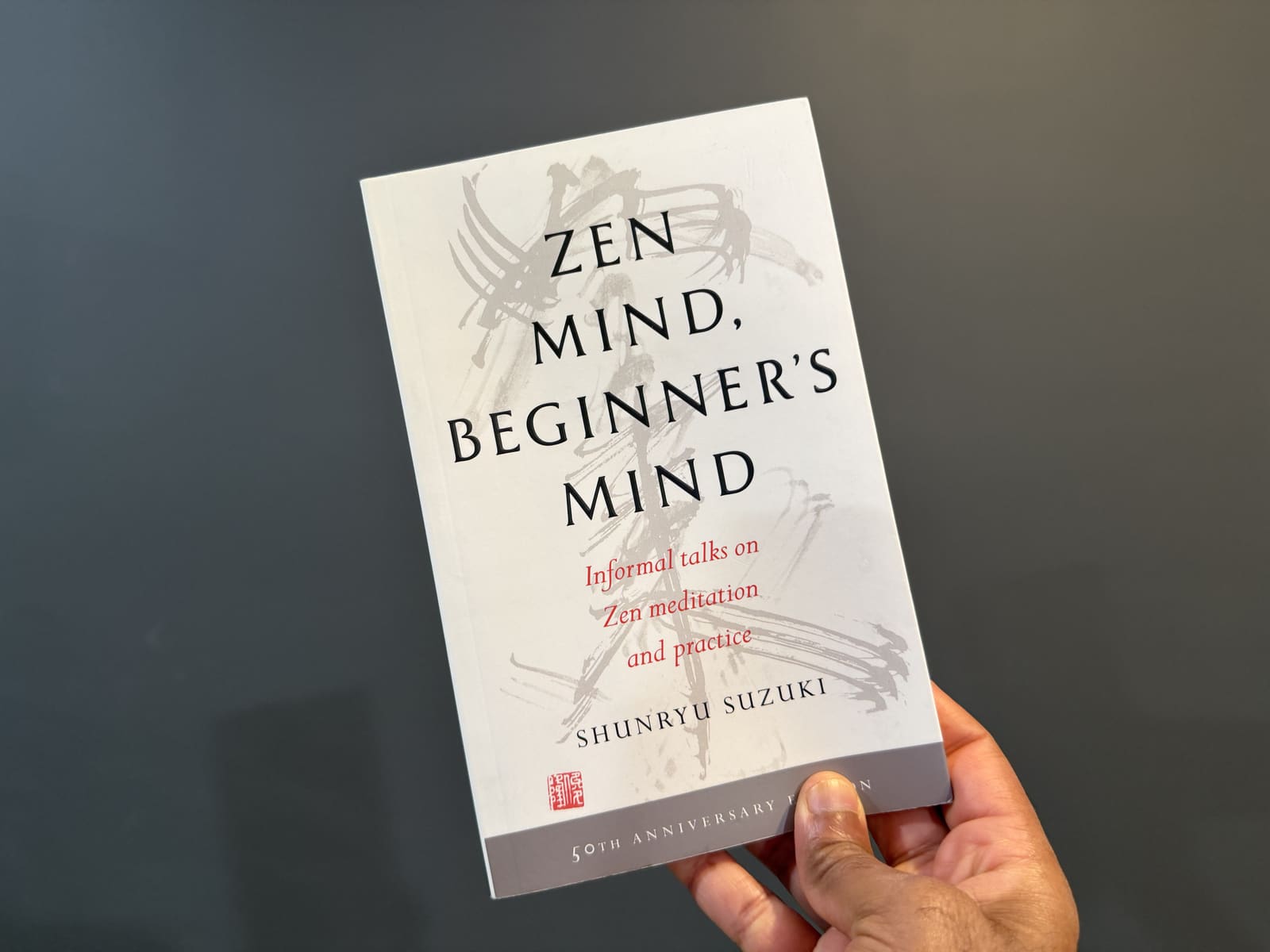
By Shunryu Suzuki
Read from 10/26/26-10/31/26
Paperback from home collection
5/5 stars
What if all the qualities you go on exotic quests to find and build up are already present, beyond the haze of your mind? Right here, right now.
This is the challenge Shunryu Suzuki sets forth. A teacher of Zen Buddhism in the West, he led talks and practices at San Francisco area Zen centers, guiding an emerging community back when such an understanding of reality was truly novel in contrast to the zeitgeist of mass-market American society.
My Journey from Expert to Beginner
Sometimes books enter your life at the right time. Zen Mind, Beginner’s Mind jumped off the shelf at a local used book store recently, so I had to read it. It’s hitting me at a fitting point in my life for a number of specific reasons.
- I’m rebooting my coaching practice after a long sabbatical and looking at everything I do through the lens of “What would be most helpful to my clients?”
- I’m reclaiming my health to be able to feel great moving over long distances for decades to come (running, biking, swimming, hiking, etc.).
- I’m “learning how to learn,” to not only be proficient in AI but to help my (now) young kids climb learning curves in school, sports and life.
In all these areas, I used to consider myself an expert. I’ve coached for thousands upon thousands of hours. I’ve completed enough Ironman triathlons, ultramarathons and century bike rides to last many lifetimes. I’ve mastered many other domains in my former career at Microsoft.
However, this feeling of mastery is part of what’s held me back (at times). It’s one thing to feel confident in your abilities; it’s another to feel like there is nothing more to learn. I hate to say it, but the line between confidence and hubris is a thin one. The feeling of being a beginner cannot be faked.
I’m Genuinely Feeling Like a Beginner Again
There is no reason to hide it.
In fact, according to Suzuki, it is a powerful state of mind. I would have to agree. It feels good to be on a learning curve. Motivation comes easier. There is less pressure of needing to prove anything. I’m also a believer that humans are built to learn and come alive when doing so. Once you become an expert, and take that label to heart, some part of you stops listening and learning, and starts preaching and teaching.
This is not only good life advice, it’s good work advice.
Just think about the leaders who most impressed you. Who was most effective? Who built the best teams? Who lasted for the long term? In my opinion, a paradox of effective leadership is that the best leaders don’t pretend to know it all. They are beginners, always, in at least a few aspects of what they do.
Zen Mind, Beginner’s Mind
Zen Mind, Beginner’s Mind was published in 1970, a year before Shunryu Suzuki’s death, and struck a major chord. It carried Zen to a wide Western audience, including a young Steve Jobs. The book is drawn from Suzuki Roshi’s informal talks, making the case for waking up to one’s natural “beginner” state through metaphor, contradiction and paradox.
The simple, and at times repetitive, style is a feature, not a bug. It helps the truth ring clear as a bell. It’s an example of how informal, less-produced books can be far superior to the polished alternative. Credit goes to his editor, Trudy Dixon. She didn’t try to make him sound like a professor. There’s just enough editing to make the book highly readable without wringing the soul (or should I say “big mind”!) out of it. That’s rare, especially in books on Eastern spirituality.
The Value of Practice
That simplicity carries over to how Suzuki treats practice, which Zen practitioners are known to do a lot of. If you already have everything you need, why bother meditating, keeping precepts or sticking to a routine at all?
He offers a middle way: practice fully, but without a “gaining idea,” that is, without fixating on reward. This idea jibes with a central theme of another classic treatise, The Bhagavad Gita: engage fully in life but surrender the fruit of one’s labor.
While I often rail against the dangers of overwork and excessive effort, the way Zen speaks of practice rings differently and fits with how I see effectiveness showing up in my life and also in the workplace. As Suzuki puts it, “When you do something, you should burn yourself completely, like a good bonfire, leaving no trace of yourself.”
Read this way, routines and habits aren’t a way to get what we lack, but to express what’s already here. That’s beginner’s mind: showing up fully, with nothing to gain and nothing to prove. Show and share what you have in everything you do. It’s a mindset worth bringing off the meditation cushion and into the ordinary work of each day.
I’ll be heeding this advice as I look to approach my coaching practice, health and learning curves with more innocence and less expertise. Maybe in reading this you will be inspired to do the same.
How about you? Where in your work and life would embracing your beginner’s mind be worth a try? Pro tip: Start with the domains where you consider yourself an “expert”!
Let me know what you think about it in the comments below.

Leave a comment below
0 comments