
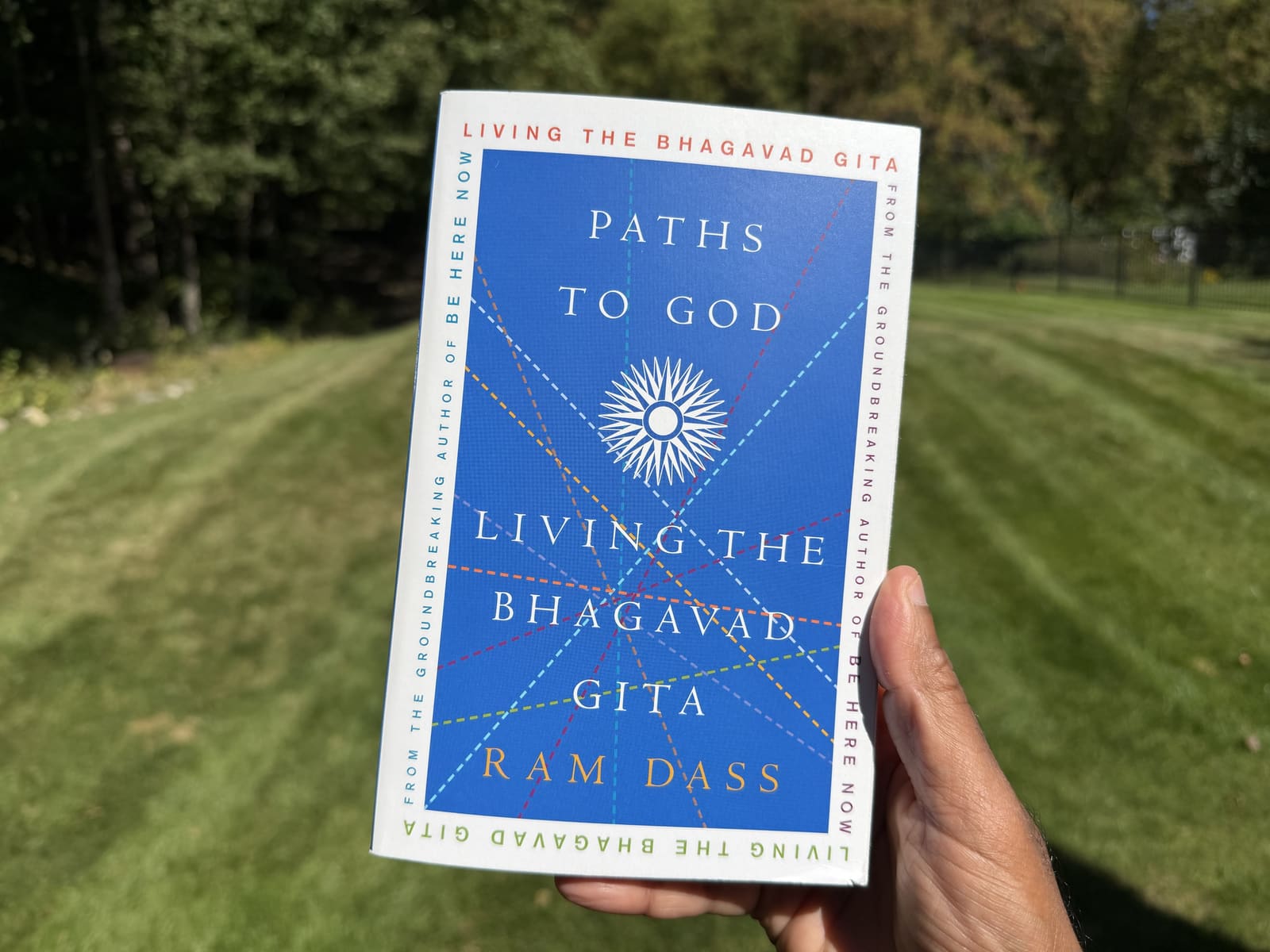
By Ram Dass
Read from 8/25/26-9/11/26
Paperback from personal collection
4/5 stars
I was thrown back into the works of Ram Dass after Duke died this year, on the back of losing several extended family members in the preceding months. The thing about grief is that it has a transformative power. I was moved far outside of myself. My intellect wouldn’t function, literally. I couldn’t do my taxes or take care of several cognitively heavy projects at the time. Lucky for me, I was winding down my coaching practice to begin a pre-planned sabbatical. I do hope that the coaching clients I had at the time benefited from a deeper presence than I have felt in years, even if my analytical mind was in retreat.
Since that time, the grief has burned off like a heavy fog melting under the summer sun. My intellect has fully returned, but part of me is different. I am drawn to different things and a different pace of life. This shows up in trivial ways. I’ve found myself listening to entire albums, instead of picking favorite songs. I’m spending more time writing and less time on social media, news, email or even TV. I find no need to rush to finish things or move faster than the pace of life requires. A general theme is that I’m more interested in going deeply into things (usually at a slower pace) instead of skipping broadly across them at high speed.
The same is true for reading. I bought a stack of Ram Dass books earlier this year and have been working through them when I’m inspired to. “Be Here Now” (a re-read) was the perfect book to soothe the pain of grief back in February when Duke died. “Being Ram Dass” was a fascinating look at the boldness, frailty, genius and personality faults that lie within someone who has done as much to usher in a new age of collective consciousness as anyone in the past 100 years. He was also very human and full of mistakes.
Just this week, I read Paths to God, another work of Ram Dass (previously known as Harvard-trained psychologist Dr. Richard Alpert). It is based on a course that he taught in the summer of 1974 to open Naropa University. It was paired with a sister course, taught by the young and controversial Tibetan lama Chogyam Trungpa, founder of Naropa, on key Buddhist teachings. The contrast between the dynamic Hindu approach to self-realization and the Buddhist view must have been head-spinning and exhilarating for the students.
The book is based on Ram Dass’s lectures, cleanly edited to be very readable in book form, but referencing his original notes and stories. The cornerstone of the lectures was his understanding of the Bhagavad Gita, one of the most widely referenced (and sometimes actually read!) books in the Hindu pantheon. He didn’t just read The Gita; he practiced and learned it through many years of self-study and mentorship by awakened teachers.
To say The Gita is a “book” understates it. It’s more like an operating system for how to be and act in the world. I say “act” deliberately since the work is directed towards those who are not looking to retreat to a cave to meditate or lie on a beach eating grapes all day. It’s about how to engage in an active life, even when what to do is not clear. It’s no surprise that The Gita has found its way into the hands of so many leaders who are faced with “the highest-of-stakes” (literal life or death) matters.
Paths to God is not meant to be a literal interpretation of The Gita. It does not explain each chapter or give verse-by-verse translations. There is virtually no Sanskrit to be found, outside of some mantras. Instead, I think about it as a work that uses The Gita as a framework for introducing the rich methodologies available through the Hindu culture and Yoga traditions, to help one achieve freedom amid a busy life.
I thoroughly enjoyed the approachable nature of it. Other commentaries on The Gita (I’ve read many) or other Hindu texts (Yoga Sutras, Ashtavakra Gita, etc.) can be overly cryptic and not take my mind to that place of deeper contemplation and understanding. The stories, even the outlandish magical ones (often featuring Neem Karoli Baba) may or may not be “true” but are entertaining and always pointed me towards a deeper level of curiosity about my reality.
On a practical basis, the exercises that are offered toward the end of the book are a wonderful, yet approachable, menu of things you can try to support your spiritual and personal growth. While written in the 1970s, these practices are tried and true. Better, they are basically free and doable in the comfort of your own home (or a park!).
The ideas and tactics described in this book are remarkably simple, but when taken to heart, can transform a life. I see too many motivated people attacking their health (mental and physical) through complex routines, potions, lotions and pills. There is a time and place for those things, but I think we would all be well-served to turn back towards some of these timeless traditions.
If nothing else, go deeper beyond the physical and mental to the spiritual. That is the unique thing about Ram Dass: I tend to stumble upon his works looking for something and leave feeling like I already have it!

Leave a comment below
3 comments
Hi, thanks for reading this far. Leave a comment to let me know your thoughts.
Loving the new look of the emails Ravi! This one came at a good time for me, as I'm also finding myself interested in going deeper on less things vs broader on more (reducing news and media I consume, reducing number of tabs and parallel Claude sessions, etc.). It was also serendipitous that you recommended Paths To God since a friend gave it to me as a gift and I haven't yet read it.. might be time to pick it up again.
Hey Kevin!
Funny to hear that about the book and I glad the mails look sharp. While I write 100% of what is on this blog, I did ask Claude to redesign my site (and email template) and it seems to work like a charm. Not to mention....this comment system, which is super basic, but again - built by Claude.