

Fred Rogers didn’t look like a leader. Soft-spoken, cardigan-wearing, mild-mannered; back in the late 60’s he was about to face down a grumpy senator who could kill his show with one vote. What happened next changed everything I thought I knew about executive presence….
But let me back up!
Think about the last time you encountered someone who struck you as exceptionally influential and impactful. What was it about them that made them so? Was it the way they looked and dressed? Was it how they communicated? Was it their knowledge? Your insecurity in light of their background and accomplishments? Was it something altogether intangible, a mysterious vibe that just hit the right neurons at the right time?
Executive Presence Defies Definition
When it comes to executive coaching, there is perhaps no more commonly discussed topic than the most meaningless of all terms, executive presence. I say meaningless not because it doesn’t matter. It absolutely does! It’s just that it’s a term that has no real definition. Unlike something in the world we can point to and clearly assess, like one’s domain expertise or even a subjective rating of communication skill, executive presence has no universally agreed upon definition.
And yet, we can all tell when we are impacted and touched by someone, who may or may not even be in a leadership position. There are times when an encounter leaves us trusting and feeling safe. Moments when a decision appears confident and firm, and as such seems to instill a surety in you. Such people seem to have an aura, a gravitas and heft about them.
This blog is about this subtle yet intangible quality that is so sought after. We call it executive presence, and by the end of this article I hope you feel that its mysterious nature is right beneath the surface for anyone patient enough to look.
What Do People Think it Means?
The last time I wrote about executive presence I referenced the work of Sylvia Ann Hewitt. If anyone can define it and quantify it, it’s her, having spent years diving deep into the topic. The key categories her work calls out: Communication, Appearance and Skill; combine as essential ingredients to create it. Each of these categories, however, are comprised of numerous ingredients. The groupings, while sensible, are subjective. Even more confounding is the fact that the ingredients changed during the pandemic, with certain attributes like authenticity and inclusion suddenly becoming more important.
Political and social norms are being recast of late. I can only imagine that the factors will once again shift. It’s hard to move towards a moving target. It’s also confusing as many people who appear to be in positions of leadership defy the norms and criteria around which executive presence is assessed. You don’t need a power suit to look the part any more than you need to have a booming voice or any specific sort of appearance. Just look around and notice how you are moved by people and what creates impact. You will be surprised that there is a wide array of ways in which influence happens. both from you and to you.
The Fred Rogers Paradox
This brings us back to one of my favorite examples of executive presence from an unlikely person placed in an impossible situation. Many years ago, Fred Rogers was called to testify before Congress in a last-ditch effort to save his show (and others like it) from getting cut. Positioned in front of a notoriously direct and curmudgeonly senator, his delivery—mild mannered, heartfelt and sincere—isn’t what anyone in the 1960s would call the paragon of “executive presence.” However, his impact was A+. So perhaps there is a lesson in there after all?
If you haven’t seen the testimony, watch it yourself.
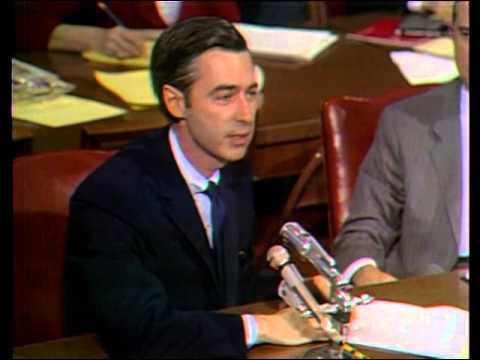
Having watched, what do you experience?
There are many things that Fred Rogers displays: authenticity, clarity, courage and more; but above all he exhibits, to my mind, a capacity to remain relaxed and calm under pressure. He strikes me as peaceful, in a circumstance that seems to be anything but conducive to one’s peace of mind! This quality of “grace under fire”? It’s perhaps the truest hallmark of executive presence. It’s memorable and also seems to be a state of mind that allows oneself to call forth more innate capabilities.
Spend enough time observing people in your life and you will start to notice that people exhibit confidence, clarity and connection in a wide variety of ways. Some are soft-spoken and others are boisterous. Some use facts and figures and others appeal to emotion. Some have an accent and others do not. Some dress up and others dress down. It’s a subjective measure but like many things in life, you know it when you see it!
Back to Fred Rogers, imagine for a moment that we could go back in a time machine and give him some coaching. What would you say? Would you tell him to speak louder? Sit up tall? Pound the table? Perhaps you would encourage him to include more statistics on the ROI and impact his program has on society. Maybe you would even have him dress up better, with a fancy suit and lapel pin!
Now, even saying these things seems silly. Of course you would never tell him to do those things, for it is exactly in his authentic delivery that the emergence of charisma and influence naturally occurs. To try to fix the delivery through micro-managing his words, style or appearance would only be in service of very marginal gains, but come at the very real cost of disrupting the natural emergence of what happens when someone shows up whole-heartedly and naturally with less on their mind.
The Power of Presence
This brings us to the reason you are reading this article, which is that you want to elevate your executive presence and want to know “How to do it!” It’s a common and big question I get from clients who work with me as a coach. The first “trick” is to simplify the exploration by dropping the “executive” and focusing on “presence” instead.
You see, one of the reasons why mindfulness and meditative practices can be so helpful for leaders is they help one gain a better understanding of the nature of the mind. By being aware of the mind, you gain distance from it, and your feeling state improves. People who spend more time in a nice feeling, born from a clearer state of mind, tend to perform exceptionally well. This doesn’t mean that you can’t perform well, and influence/decide/lead, with a lot on your mind. It just means that if you have the choice, you are better off approaching your work and high stakes moments with less on your mind!
Most people find it hard to believe that their best performance, and highest levels of clarity and connection, can emerge from a relaxed and peaceful state of mind. Perhaps it’s our society’s addiction to effort and a “no pain, no gain” ethos many of us were taught when we were younger. Perhaps it’s just comforting to believe that if we only work hard and suffer enough we will get where we want to go. Neither of these are true.
What does seem to be true is that we live in the feeling of our mind. If that feeling is noisy, it can (and will) throw us off balance. If it is settled and fluid, we can remain in a relaxed state of mind, even in the heat of the moment.
Don’t believe me? Try the following experiment out for yourself, something I often guide my coaching clients to explore:
An Experiment For You
To get the most impact out of this experiment, sit back and follow these instructions slowly with a reflective and relaxed state of mind:
Take a moment and remember a time when you were peaceful and effective. It might have been a moment of influence and confidence when you were presenting ideas to others. It might have been a time of creativity, when you came up with (either alone or with your team) a solution to a major issue. Whatever the time was, you were peaceful and highly effective.
Spend 2-3 minutes on this memory. Bring the feeling into your body and mind now so you can get a grip on what it was really like. If nothing comes to mind immediately, that’s normal—try thinking of moments when you felt “in the zone.”
Next, take out a sheet of paper and reflect on the qualities that were present for you during this time. These qualities are adjectives that describe what you were like during this time. Were you really confident? Patient? Creative? Collaborative? Persistent? Calm? Motivational? Something else entirely?
Repeat this exercise a few times, each time calling forth a time when you were peaceful but effective. Notice the qualities that were present, and perhaps even felt like they flowed through you. Really feel those qualities within you as you recall those memories. Most people are surprised to find qualities like wisdom, humor, or decisiveness on their list.
Now, have you done the exercise? Good!
Review that list of qualities you wrote down.
Now ask yourself: Where did these qualities come from?
If you are like me, this last part will give you pause, or even be confusing. This isn’t a bad thing, it’s the sort of confusion that occurs when the mind is thrown for a loop. You see, we’ve been raised to think that everything good in life we need to work hard for. Even the human qualities we are born with (do children not have abundant confidence and charisma?) seem to be missing unless we somehow force and work them into existence!
However, as you surely got a feel for, if you did the exercise I just shared in a heartfelt way, there are miraculous and impactful qualities lurking right beneath the surface of your mind, waiting to be revealed.
The real question is: How can you more consistently bring those qualities out of yourself when it counts? We will get to this matter shortly, but for now, it’s worth underscoring the value of seeing that the capabilities and qualities of “executive presence” are not existing in a far off land, only to be uncovered through years of toil. They are lurking right there beneath the surface and waiting to emerge. Your knowing this fact is a very helpful part of the process.
The Story of Alice
A few years ago I was approached by a leader, I’m calling her Alice, who was just promoted to Chief People Officer of her mid-sized company. A skilled HR leader, Alice was overjoyed at the vote of confidence. Then came the bad news. Her new role came with additional responsibilities and the dubious honor of joining board meetings and running the monthly team all-hands.
When Alice approached me for coaching she wasn’t sleeping well due to stress, anxiety and a feeling that she didn’t have what it takes to operate at this new executive level. To add fuel to the fire, she was told (by one of the other leaders at the company) that her strong European accent made her hard to understand. She reached out to me asking if I could “pull a rabbit out of a hat,” and help her fix her communication issue and regain her confidence. I told Alice that I couldn’t guarantee anything, but was certain I wouldn’t make matters worse.
We had one session prior to her next all-hands event, in which we explored how to be more present and allow her thoughts to flow along naturally. What I noticed (and she did as well) was that her communication was clear and completely understandable (and in fact, quite endearing!) when she was relaxed and feeling slow in her mind and settled in her body. She also noticed that when she dropped out of her thinking (which was mostly judging her communication), and got present to people around her (including me) she felt fine. Her peace of mind returned, and with it, her communication, confidence and creative spark.
Next up was the all-hands, something that used to create unbearable stress and jitters. I mentioned that during the event, not to do anything different, but pay attention to her state of mind during it. Her job was to see if she could notice the times when her mind settles and her capability and skill rises to the surface. She agreed.
The following week, when we caught up, I asked Alice how it went. “It was incredible,” she said. While she was a nervous wreck before the event, she noticed something shocking occur as the event began. Within moments of speaking, and her attention shifted from her thinking to her audience, her mind settled down and she was able to step into a flow and rhythm that supported her moderating an hour-long discussion on tricky questions about company politics, strategy and more with her executive team.
She was also a bit confused, as she wasn’t sure what, if anything, I did to help her improve!
Frankly, I didn’t do anything special. I simply pointed out that when her mind settled, and she dropped into the present moment, she was able to show up with all the capabilities she needed to meet the moment very well. This one insight—that her capabilities were right there, hidden in plain sight, was so profound that even her accent no longer seemed like an issue. In fact, she fell back in love with it (and her team didn’t seem to have an issue with it either).
The Paradox of Presence
In the search for that elusive quality we call “executive presence,” we often look outward for techniques, strategies, and external validations. But as we’ve explored throughout this article, the most powerful form of presence emerges not from adding more to ourselves, but from removing the noise that obscures our natural capabilities. The paradox is that your most impactful self emerges when you’re least in your head and most in the moment.
Remember the exercise I wrote about earlier? Those qualities you identified, they’re already within you! They don’t require herculean effort to attain; they simply need space to emerge. In my years of coaching executives and young professionals alike, I’ve seen this pattern dozens of times: the breakthrough often come not from learning something new, but from unlearning the habits that keep us trapped in our heads.
In our hyper-busy world, developing a practice that helps you reconnect with that settled state of mind may be the most valuable leadership skill you can cultivate. Whether through mindfulness, coaching, or simply paying attention to your innate and vast potential and capability, you’re building the foundation for authentic executive presence.
What to do?
So the next time someone tells you that you need more “executive presence,” take a deep breath.
Rather than adding another item to your to-do list, consider what you might surrender and let go of instead. The most influential leaders aren’t those who’ve perfected an external persona, but those who’ve learned to access and trust their natural capabilities. Your unique form of presence is already there, waiting patiently beneath the surface of your busy mind. All you need to do is get present enough to let it shine.
Sometimes the most profound insights come from the simplest experiments. If this resonates with you and you’re curious about uncovering your own natural presence, I’d love to hear about your experience what I’m talking about. Leave a comment to this article or learn about and apply for coaching if you want to dive even deeper.

Leave a comment below
4 comments
So true. Brilliant.
I’m glad you found that my article resonates!
thanks so much for writing this. so simple yet so true. I am new to coaching, but the issue of having "more" executive presence is quite common across clients. I will be sharing the link to your piece.
Thanks I'm glad you find it helpful Annalisa.