
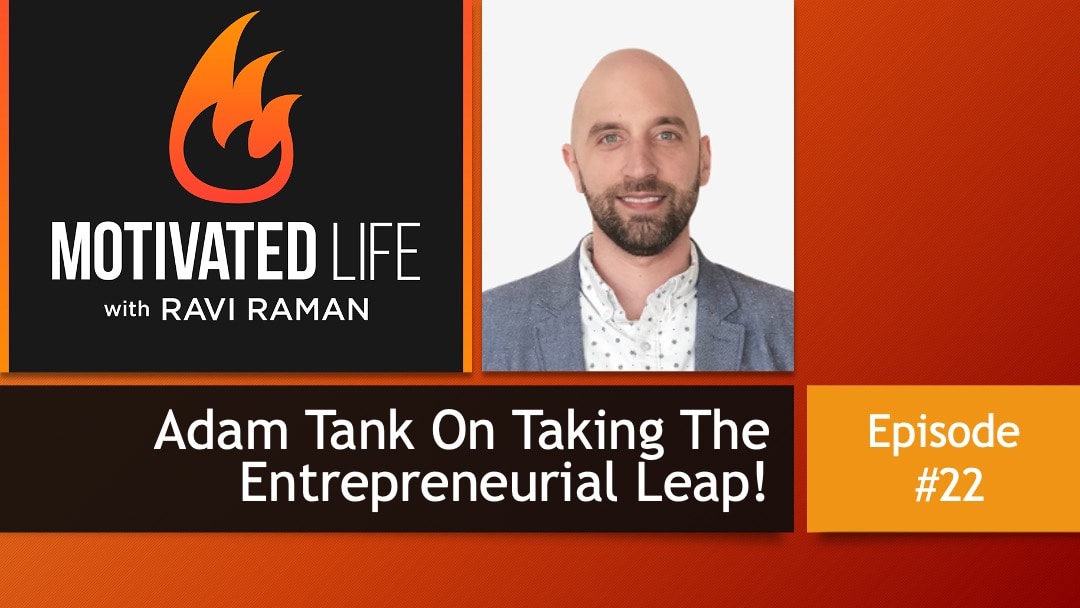
Adam Tank joins me on the podcast to explore what it’s like to leave the safe confines of a corporate career to find his way as an entrepreneur. We also dive into his passion for the water industry, the value of writing and blogging, the key qualities of an entrepreneur and much more. Connect with Adam, and check out his writing, on his website and on Twitter. Watch the full interview on YouTube!
Adam Tank On Taking The Entrepreneurial Leap [Podcast Ep. #22]

View the full transcript
Transcribed from the episode audio by AI, so it may contain mistakes.
Ravi0:20Welcome to the Motivated Life podcast. I'm Ravi Raman. On today's episode, I bring you Adam Tank. Adam is the director of digital transformation at Transcend, which is a software company that at their core help companies build strong and secure software that takes design engineering to the next level. And their software solution is used to actually support water treatment engineers and utilities in building better water solutions. And so Adam is a geek when it comes to water. He loves everything about water. It's been a big part of his career so far.
And he's an example of someone who has made the leap from working in a big company to being an entrepreneur and now working as a leader in a small startup that's looking to grow. Now, I encountered Adam through Twitter. I recently got back on Twitter and started using it for what I think is the most useful purpose to use Twitter for, which is to actually connect with people. And I saw some of his tweets in my feed. I hadn't met Adam before. And I just found that he had some really interesting thoughts about entrepreneurship, about writing, about personal development.
And after learning his story of having worked for several years at General Electric on a leadership track, and then having made the leap to create a startup and now work as part of a leadership team at another startup, I thought he would be a great person to speak with. I know many of you are working in big companies and wonder what's it like to make that transition from the safe or seemingly safe confines of a big company to go work in a startup or perhaps create something on your own.
And there are many of you who are already running small businesses who perhaps would like to hear Adams take on what entrepreneurship is all about, and what he sees is some of the key aspects of leadership that are necessary for any entrepreneur to have. So we talk about a wide range of topics, both career, the merits of working in a big company versus small company, the role of writing and personal branding, as well as how important it is to pay attention to sales and marketing, even if you're a product-focused founder.
So I'm really excited to have this chat with Adam. As always, if you enjoy the show, please leave a review, like, share it, and feel free to contact me if you have ideas for things or people you'd like to hear about on future episodes. And with that, I bring you Adam Tank. Adam Tank. Thanks for joining me.
Adam3:10Glad to be here, for sure.
Ravi3:13So Adam and I have not met in person. This is our first time, but I feel like I've been living in Adam's head for a few weeks because I've been reading, Adam, I've been reading your tweets and reading your blog and some articles on LinkedIn. And I have this image of you as someone who is a bit of a polymath who cares about climate and is a water geek, which with a last name like tank, I mean, that's like perfect.
Adam3:42Sort of have to be, right?
Ravi3:43Sort of have to be. But also cares about personal development and learning, and innovation, just in general innovation. So I have this idea in my head of someone who, you know, cares about water, is a water geek. Oh, loves to write, which is how I first heard about you through a mutual connection, Dave Perrell. I recently went through his amazing write of passage writing course. Okay, great, great. That's initially how I heard of you. and then I started seeing your tweets show up in my feed, having been retweeted by some of my friends and figured it would be great just to get you on and talk a little bit about your journey and your career and also pivots you've made in your career with my audience.
So again, thanks for joining me. And I'd love for you to tell me my description of you, how far off the mark am I? And you could set the story straight, I suppose.
Adam4:39That's pretty damn good. And obviously it's tough to get a feel for personality. Some of that can come through on writing, but I really feel like you have to meet them or see a video of them speaking to gain the full picture, the full context. So I hope that this might add another dynamic to what you've already said, but I would say those are all definitively true. And the other big one for me is entrepreneurship or small business and volunteering with people or talking to people and encouraging them to fulfill their dreams when it comes to starting their own venture or just basically becoming self-sufficient independent well
Ravi5:18why do you share a little bit about your backstory the long-form version i mean who are you where you from and maybe if you can trace a bit of the arc of your career so far and what you're doing now
Adam5:29i grew up as one of the only gringoes little white kids in a block in school full of Hispanics, San Antonio, Texas. And although I didn't know it at the time, that has definitely shaped my worldview relative to interest in experiencing new cultures, flavors, foods, people developing this trade about wanting to learn just in general, being passionately curious about anything and everything. And as I have sort of grown up, that's been a theme that's been consistent throughout my whole life. So I've gotten a chance to travel.
quite a bit. I got a chance to live in Brazil early in my career. Started out as a microbiologist, found out that I was far more interested in business strategy, business operations, sales, marketing. So eventually made a career transition into that. But then it's really become excited about entrepreneurship, small business. We'll get into why here in a second about the water industry, as you mentioned, also very passionate about that one. And then this sort of new skill set that I'm developing, which is writing. And we both have, I guess, David Perel to think, David Perel to thank for that and write a passage.
Ravi6:43So let's talk a little bit about your work history. So you spent a lot of time in the water industry and thinking about innovation relating to water. And for me, for most of my life, I've never really thought about where my water comes from. I turn on the tap and that's it. I just knew we had, my friends would come over. We grew up in farm town in Pennsylvania, we had a well. And so friends from the city, which was the town of 5,000 people would come over.
And they're like, your water tastes like eggs. And so I got the sulfur in the water. And so I got a little curious about water there, but mostly I haven't really thought about it. I try to buy spring water when I can. But it seems, especially from reading a bit of your writing, I've gotten more curious and looked and realized there's a lot more to the story of water than we think. So I'm curious, what got you engaged in water and how is that rippled through your career?
Because you've had several roles thinking about water in cities and how to make cities better and give us water, which we all need. I
Adam7:58didn't think much about water before stepping into a career with GE in grad school. But what's interesting, and I would say this goes for pretty much all of us, if you think about your daily routine and every component of that routine that involves water, you start to gain an appreciation for just how important it is. So most of us wake up in the morning, we use the restroom, requires water, unless you're going outside somewhere, which case, you know, you may be one of these like off-grid non-Twitter types.
So probably not talking to that person. You brush your teeth, you have a glass of water, you drink milk, you know, turn on the tap to take a shower. I mean, just your morning routine in and of itself, you realize, man, if I didn't have access to 24-7 clean tap water, my life would be completely different. And I sort of retrospectively realized just how important water was after I stepped into the role of GE. But since then, I've come to gain an understanding and an appreciation for not only how important water is around the world and how many people don't have access to clean water, but also how challenging it is to maintain the infrastructure that treats, distributes and collects the water that we do use.
And I think it's one of the biggest challenges of our lifetime and one of the most complex in terms of financing, business, innovation, technology. I mean, it's all of it's wrapped into one. And I love that. I love the complexity of the problems.
Ravi9:43So when you say most people listening won't be aware of, like, what is the water industry? The way I think about it is there's like, I don't know, a water treatment plant. that gets water to my house and hopefully it's clean. Like, what's involved in that? Seems like there's a whole industry around it that I'm just blind. Most people are blind to.
Adam10:08Water, not only in our daily lives is, you know, obviously a big component of being able to live. But our entire economy is largely centered on the fact that we have access to water. If you go back hundreds, if not thousands of years ago, most major cities were developed on or near water. And there's a reason for that. I mean, water is the source of life. That's the first thing we look for when we go looking at other planets to see if there's life, is the absence or presence of water.
That's how important it is. And so what's happened is this cold water industry has been built up over time, which is not only water utilities, as you mentioned so the people that bill you for your drinking water or bill you for your sewage but then also industrial water and wastewater treatment. All the manufacturing plants have big, big water aspects, either in their manufacturing themselves or in cleaning their equipment. Um, and I guess the other, the other big component of this industry would be the technology. That may not be specifically water technology, although there's plenty of that, but bringing in technology like internet of things, digitization.
So smart metering would be a great example of that. So instead of somebody coming and walking out to your house every day to record the numbers on a meter, that data can now be sent to the cloud.
Ravi11:39Which I have, well, I have for my solar, not for my water.
Adam11:43Okay, okay, okay, gotcha. Yep.
Ravi11:45Yeah, yeah, I see. Yeah, it's interesting. And so at GE, you were thinking about the technology and how to support that whole value chain in the water industry. That's right. Okay. And how long did you spend in that environment working in GE in that corporate? I think of GE as, so my background, I worked at Microsoft from 2000 to 2014. When I first joined Microsoft, we would look to GE as the paragon of leadership and management and business structure since changed. But in those, in those, days.
We used to read Jack Welch books. My boss handed me a copy of Jack Welch straight from the gut and said, you should read this. So how long were you there and what was it like working in that environment just from a day-to-day work experience
Adam12:36Standpoint. So I see my my experience as a GE and the first company I worked for out of my undergrad General Mills as being very similar. Like most large companies, Microsoft included, I had plenty of friends there. There's a certain amount of bureaucracy and politics and layers of management that you typically have to go through to make decisions, and that's ultimately what drove me away from the big company life. So, at GE, I was there for about 18 months after grad school, not including an internship between the first and second year of my MBA, and I came to realize it's very hard to have control over your career when you're inside of a big company.
And that could be functionally. So, hey, I'm an engineer and I want to become a salesperson. It takes many years, a lot of politics, a lot of networking inside the company to make that happen. But then also, I want to progress, I want to be promoted, I want to have this job. In many cases, there's no short circuit to that. You have to do your time and hope that people retire, hope that they open up a new role, whatever it might be in order for you to get somewhere.
And that just didn't sit well with me. I always wanted control over that.
Ravi13:58So then after GE, you moved on, where did that lead you to next?
Adam14:03So this is, I think, a pretty interesting story. GE ran an entrepreneurship competition inside the company. And I'll call it Shark Tank, if you've ever seen the show. I'm sure a lot of people have. And they took 100 ideas from anyone in any division of GE. Even mine, GE at the time had 50,000 or 100,000 employees around the world. They said, we'll take the first 100 ideas that come in. We'll down-select to 10. And then those 10 will come and present to the president of GE Ventures and the CMO of the company at the time.
And we'll select a winner of this competition. And the winner gets to fund their idea, spin it out of GE as an independent business, and then move to San Francisco and run it as a. a startup. And I ended up winning that competition. So GE afforded me the opportunity to move to San Francisco, raise venture capital, and start my own technology company, just like you or I would if we had an idea and wanted to go raise money from a VC, except I had the GE backing from day one.
Ravi15:12What inspired you to enter that competition?
Adam15:15I had been working with a large private water utility in the US and their head of innovation was slamming his hand on the table saying I don't need more software, what I need is. And then he proceeded to give me, like basically, a product spec sheet for the product that I needed to build that he would then buy if I built it. So that was, that was the genesis of the idea, and I thought, man, if I could do this as a startup, this would be really cool.
So I went ahead and applied with that idea, got accepted and then he became my first customer.
Ravi15:49where did that lead you so from there you're still under the purview of GE
Adam15:53so I was their bootstra
Ravi15:55they're they're funding it but you're still part of GE
Adam15:57So I, for a year I was still an employee technically an employee of General Electric, but I was the CEO and founder of my own startup. And then, at a year, the decision was do you stay or do you come back into GE? And I decided to stay and run the startup. Okay, so I, yeah, I continue to. I continued running that startup for another year and a half, two years, And then we were approached by an acquirer in the water industry And I felt that was the best decision for the business, because my goal from day one was to get this technology into the hands of someone that could scale it and grow it.
And for me to do that would have taken 10 years, tens, 20s, 30 millions of dollars and probably a lot of brain damage. So I decided to have them acquire the technology and moved on.
Ravi16:55Moved on. So where did that lead you next?
Adam16:59So the next role was with another water company. They wanted me to spin up their smart cities division. And I should have known better, but going back to a big company was exactly what it was when I was at GE or at General Mills. and I felt that the bureaucracy and just how difficult it can be to get decisions made it just wasn't for me. So I gave it a year and then an old colleague of mine from GE actually called and he said, hey, we're getting ready to spin a software company out of a parent company and I want you to come and help me run this thing.
Are you interested? And I said, sign me up. I'm ready to take the startup leap again. So that's where I am now. That's where
Ravi17:39you are now. Okay. And so what, let's camp out on that moment because you're going from a company to essentially CEO of a startup, right? What was that like making that decision, you know, leaving the protection of the big company to do something where I'm assuming there's some real skin in the game for you, right? You didn't have, I mean, did you have financial backing or investors at this point or was it just sort of
Adam18:12GE. GE financed the we'll call it pre-seed round, and then another Bay Area investor stepped in as well. So I had that backing, but I never took a salary when I was with that company And all of the investment went to the employees that I hired and our product development And then any sales and marketing efforts. And so you asked what was it like at that time? Single guy, no obligations to anyone but myself, basically, and I wasn't scared of moving. I had done it before, I'd moved to brazil and didn't speak the language, so was ready to take that leap.
And so for me it wasn't that nerve-wracking, especially because I had connections to the industry. I knew who I would sell this product to, I knew how to market it, so that the. To me, the difficult thing about doing your own thing is can I make money and support myself doing it, which is a function of can I sell my services or my product? And I knew in my gut that I could sell it.
Ravi19:19How do you know, how do you, let's talk about that, because you knew in your gut, what is that, how did you know in your gut? I
Adam19:26mean, I had mentioned that I had spoken with that big water utility. And when the, when the person that owns the budget that's responsible for bringing innovation into the company and understanding the art. and understanding what the product needs to be tells you exactly what it is that you need to provide, I know I have a sales partner there, or a sales, a sales, a first customer. That then was further solidified when I went and interviewed other water utilities for my customers. And I said, hey, do you suffer from the same problems that these people suffer from?
And if I built something that looked like this, would this be of interest to you? And they all said yes, without a doubt. And in fact, what it? What it needs to do is x, y and z, and I would buy it for this cost. And you know, the list goes on. What I think a lot of entrepreneurs do is they think they have this great idea and that if they build it, people will come, which is just not the case. It's just simply not the case.
So I mean, here's an example, ravi. So I know that you, you ventured out from microsoft. You have your coaching business. I'm certain that you believe that thousands of executives and people in the us need coaching, And I also believe that that's true. But if you don't know how to reach them and they never hear about you, you'll never sell your service. Right. So the challenge is sales and marketing, not necessarily the service or the product that you provide. Because that's how I've always felt about it.
Yeah,
Ravi20:56exactly right. And I think we both love to write or at least have used writing to help get our word out. We'll get into that. But it definitely sounds like, just like me when I left Microsoft, I didn't know what I would be doing next. So I very much took a step into the unknown and eventually stumbled into something that I loved, but also knew there was a need for because I was serving people like who I was. I was client number one for the service I was offering.
And I understood the industry and the need. So that part was there. It was a question of sales and marketing to make the connection point. It sounds like same thing with you. You understood the need. It was a matter of making that connection point. And also, it sounds like you had that entrepreneurial streak for a while. So there were glimmers of it throughout your career. That's right. That made it less of a more of a no-brainer when the opportunities came. Let's talk about product versus sales and marketing because it's all the rage now to talk about product, product, innovation, technology, new idea.
It's, I mean, it's starting to become a little bit more okay to talk about marketing and growth marketing, but it's still an afterthought. I'd love to hear from you, what's the role sales and marketing is playing as you think about your new company and what you're up to relative to actually building the core product and how you spend time on both and the importance of both of those?
Adam22:24I still believe, and I believe this is true for most companies, that how people hear about you and how they buy from you determine the success or failure of your company. Some people that are product-driven would say that your product is your best source of new leads or deals, because if the product's that good, it'll go viral, word of mouth, everyone's going to use it, they're going to share it with all their friends, and that's the best thing you can do. That may be true in some cases, but I would say for most industries, that is not, that is the exception, not the rule.
The rule is for me, and it always has been and it probably will continue to be, unless I'm at one of those product first companies that just is the greatest thing in the world, is that 90 plus percent of your effort should be spent on sales and marketing. And by the way, that doesn't mean pitching your wares. It means listening to the customer, understanding their needs, finding out what the real problems are, understanding how, they make decisions, understanding what the budgets look like, understanding your ROI of your solution.
To me, that's all sales and marketing. It's not just, hey, can I serve people ads, or what does my copy look like, or what's the sales strategy with this account? So there's a tension between product and sales, but I always lean on the sales side of things because I think a lot of problems in startups and big companies, for that matter, can be solved with more sales, is one more cash. You can figure out the product when you have the money to do so. Pay
Ravi24:01salaries. Make sure you can figure your salary. Keep the lights on. It's
Adam24:05hard to build a product if you don't have product engineers or product people. So you need money to pay
Ravi24:11them. That's right. So can you just summarize this? I realize we probably didn't touch on the essence of what your company does. Like what's the core mission of your company right now?
Adam24:22So we are here to change the way, engineering firms design infrastructure and ideally help them incorporate innovation and sustainable technologies into their designs
Ravi24:37gotcha okay and uh so now let's let's talk a little bit about your journey as an entrepreneur i'd love to hear um what it's been like for you what's been great about it and also what are some of the challenges and roadblocks you've encountered that you didn't expect along on this journey.
Adam25:03So the, the, what I love about entrepreneurship is that no two days are the same. When I was running the robotic startup in San Francisco, I was literally scrubbing the toilet. And then two minutes later, I was sending an email to an investor. And that's, that's the beauty of startup life is that you do anything and everything. and you have to have your hand in a bunch of different pots. What I don't like about startups, especially today, is that this idea of venture capital and financing early stage ideas before they have any real traction or profitability is being glamorized.
And I think it's a disservice to the world of entrepreneurship. Because people forget that entrepreneurship is more than just venture-backed companies. If you're on Twitter, you don't think that's the case. But the truth is, a very small minority of all startups. Get venture-backing, and then, of course, even a smaller fraction of those go on to be successful. The bulk of entrepreneurs, at least in the U.S., are people that own small businesses. They're your corner store owner. They're your janitorial services. They're a painting company. They're your dentist.
They're plumbers. There are these types of folks who make a great living for themselves provide valuable services to the community, but nobody talks about them. So what I hate about entrepreneurship and what I wouldn't have expected was that people glorify the things that I don't think they should glorify. And it's always tough to sort of wrangle people back in and say, yes, it's great. It's great that we just raised all this money. But what we're really here to do is this. And this is the important thing.
This is what we should be focused on. You know what I mean?
Ravi26:55And you're active on Twitter and also blogging, and you know I personally believe that writing is thinking and so writing is just. It's something I've always done privately or on a personal blog, or now I blog more about coaching related topics that are relevant to my audience. What does writing do for you and what role do you see both writing and also being active on social media relating to your business, like what? What value is that providing to your business? Or do you just do it because you think it's something you enjoy doing and you want to do it?
Just like I enjoy skiing has no bearing on my business. I enjoy skiing, so I ski. What is writing do for?
Adam27:43You so writing. I'll talk personally first and then about the business second. Personally, it is a way to, as you mentioned, think, clarify my thoughts, solidify my thoughts on a given topic, condense those thoughts and then put them into public forum so people can debate, which I love. I love. I love having that back and forth. I love the twitter dm conversations. I love the comments I get from my blog post. I love when people just reach out to me and send me emails and say hey, what do you think about desalination, right, or whatever water topic of the day it is.
The other thing, though, that writing does, that I wasn't expecting but has been a tremendous blessing, is that it's actually a. It's a great way for me, as a what I would say is generally a lazy person, to sidestep a lot of conversations like hour long conversation that I'd have to have to have if I didn't have a piece of writing, or if I didn't, if I hadn't already answered that question in writing. So a good example of this is that in write a passage, one of the first.
Assignments you have is your frequently asked questions assignment, so what are? What is something people typically ask you that you can write an article about or an essay about? And if they ask you, you just point them to that piece instead of having the conversation. So the first one I wrote about was, what do you do? People ask this all the time, what do you do? And I'm like, I'm tired of answering this question. When most people ask, they don't really care what the answer is.
So if they're that interested, they can read what I wrote about. And if they like it, then we can have a conversation about it. So me personally, that's what writing does. And it's, it's been fantastic. I mean, it's only really been since March or April. I took write a passage. And I mean, this opportunity, you and I wouldn't be talking right now if it wasn't for that. So right.
Ravi29:30Right. I mean, this is the case in point, just Twitter DMs, which by the way, I was on Twitter early days, 2008 or so. I just consumed, I lurked, I used it to read news. Then I tuned it out. and I just got it back on this year using it for what I think is the best reason to use Twitter, which is to actually connect with people. Yes. And that's how we're talking right now just through Twitter DMs. Well,
Adam29:52it's funny because LinkedIn is supposed to fill that void. You're supposed to be linking with people.
Ravi29:58But in reality, I enjoy LinkedIn. I
Adam30:00do, too. I do too. But you don't, I don't think you get as good of a feel for who the person is because Twitter is a little less filtered. It's much more stream of consciousness.
Ravi30:12Yeah, I definitely feel, like just browsing your Twitter feed, I felt like I had this whole story about you and what you were about. LinkedIn, I don't get that. So I definitely understand that difference there. How are you using? So is the writing still more for you, Adam Tank? Are you using it in your business at all?
Adam30:30Are you blogging for your business? Yeah, I also use it in the business. So I do do some content marketing for transcend or startup. I certainly, use it when we apply for funding or apply for accelerators or are writing proposals to clients. I mean, writing comes into, you know, comes into the picture every single day. So in that sense, I use writing. But the other one is that I mean, I'm all about like give, give, give, give, give. And then at some point, if you have to ask for something, then you can because you've given so much.
And so for me, the goal of my Twitter, the goal of my blog, the goal of my LinkedIn posts is just to put good info, data, stats, things for people to think about, just put it out there. And people like, hey, this is interesting. I actually get something from this. It doesn't take out much of my time. It helps me think a little bit differently. And then when it comes to the point that I do post something where I want to engage in business, people sort of have an idea about who I am.
They're more willing to engage. They're more open to the idea of talking to me. I just think it's nice to have a different side of someone than just constantly being blasted with, hey, buy my stuff, stuff, buy my stuff.
Ravi31:43So I want to get your take on something, entrepreneurship. Do you believe that entrepreneurship is something you've, either you've got, like either it's nature versus nurture, do you think some people have natural entrepreneurial streaks to be able to go out on their own and create something? Or do you think it's very much a skill set that you can learn? And anyone can be an entrepreneur. I'm curious how you see it. This
Adam32:07is the ultimate question. And someday I might write a book on this because it's, I love talking. Yeah, I love talking about it. And my thoughts aren't quite solidified yet, so we might struggle here defining them. But what I would say is that most entrepreneurs share a set of personality traits that are fairly well defined. The hard skills, no one's necessarily born with those. And those can be taught. So I think an entrepreneur needs to understand how to sell if they, they don't know how to sell, they need to understand how to hire people that can.
Those are skills that can be taught. But you can't really teach something like an appetite for risk. And I would say most entrepreneurs have an appetite for risk. But what's funny is that a lot of entrepreneurs don't feel like they're taking a risk when they go to start their own business. What's
Ravi33:03That about? What's that about? I've heard that for many people where I have several people I've coached who stepped off amazing corporate careers, left behind tons of stock, to go try something for a year in the one case I'm thinking about it failed, went back to another tech company and was like, yeah, I just wanted to try something and there wasn't. You know, there wasn't the feeling of like free falling that I would have if I did that. What do you think? What's that about? I
Adam33:33think it's it's probably a function of how much cash they had saved and knowing they'd be okay and they can always go back to a big tech company But the other one is, like you, maybe you had an idea before you left. Hey, if I go and leave and start this coaching business, can I get 10 of my colleagues signed up before I go so I know I at least have something to fall back on? So many entrepreneurs feel that entrepreneurship is actually all about mitigating risk.
It's not about taking more risk on. Mitigating or managing risk. And they would rather take a bet on themselves to be able to manage that risk than take a gamble. on the corporate entity to manage that career risk, the product risk, the financing risk, that they have little to no control over. They'd rather, yeah, they'd rather place the chips in their own corner, right, than disperse them. Yeah, that makes sense.
Ravi34:25It's an interesting topic. Also, now there are just so many ways to be an entrepreneur. You know, there are, you can be, you could be into anything and build a business online. Like I said, we both went through this course by Dave Perrell. Hopefully, I'm pronouncing his last name, correct. He's a, you know, sort of a polymath loves to learn and loves to write, and he's built a business around that. So the definition of entrepreneurship is also broader now.
Adam34:55It's very tough to define. Yeah. Very difficult to define. How would you define an entrepreneur in today's day and age? Well,
Ravi35:02you know, it's, I'm with you. I don't know. I never thought of myself as an entrepreneur.
Adam35:09um even today i
Ravi35:11Still don't. To some degree. I've been on my own for six years. You know, started with, started with, you know, empty business bank account and just started it up and built it brick by brick, so to speak. But I've, you know, I'm a independent executive coach. It's what I want. It allows me to give high touch service to my clients and it's working quite well for me. And I've never struck myself as a kind of super risk-taking person, though other people have seen what I've done and are amazed.
Wow, that must be super risky, especially people who know a little bit of my story. It never felt risky to me. I don't feel like the archetypical entrepreneur. I just feel like someone who somehow stumbled into something that I genuinely cared about, which is personal growth and being well, wellness and personal growth. And someone who cares a lot about people who like I was trying to make their way and companies trying to build great things and stressed out and at times struggling. And so to serve that audience just brings me tons of joy.
So for me, that's my primary motivation, which isn't how I've thought about entrepreneurship, but it's working for me. and I guess goes back to the point of there are lots to me there are just lots of ways to be an entrepreneur though I agree like you said you have to learn how to sell and market otherwise
Adam36:40that's right not going to work that's right so like so you are you're never concerned that your next coaching client won't be there or that tomorrow the world goes to hell and no one has the money to pay you and well it's very
Ravi36:54what's interesting no I'm not and I think because I used to even run certain teams that were doing startups in the company, but backed by Microsoft. In fact, I spent two years on a product as the product manager on a product that never saw the light of day. I think some of the technologies now made its way into eventually Skype and now Microsoft Teams. But anyway, it was very different doing entrepreneurial stuff in the company than it is now just having conversations and enrolling new clients or seeing how we can work together.
It was night and day difference. Like the the feeling of ownership skin in the game of it's me. They're hiring me. If it doesn't work, that's on me. And so it definitely feels very different. But what I what's very counterintuitive is I'm also just not as concerned about it. I just sort of trust that things will work out. It's like I've learned to dance with life a little better and trust that I can pick up a new dance move. I don't need to figure it all out ahead of time.
I'll figure it out. So there's definitely a trust in self that I've noticed for myself that I've also noticed some CEOs of big companies also noticed because at that level, you also have to trust yourself to a vast degree.
Adam38:23Very interesting. I mean, you are a quintessential entrepreneur you started with nothing this is like the the entrepreneurial story that everyone thinks through right the person
Ravi38:33i had connections i was going to
Adam38:35say sure like yeah i mean 14 years at microsoft is maybe
Ravi38:38not necessarily that i wasn't worried about you know being out of the
Adam38:41street so yes yes but but even so you know you you have to make it on your own you don't have the backing of a big company to serve ads or do marketing for you to write content you had to pick you had to figure out what your coaching protocol or routines look like. You had to figure out what's best for each person, right? Who are you going to take on? Who are you not? What the price point's going to be? What the value? I mean, that's everything entrepreneurs do.
And you had to figure that out effectively from scratch. Yeah. Yeah. Which a lot of people would think is risky because, I mean, how am I going to become a coach? Either I've never been coach or I've never been a coach. I don't know what people need. Am I really providing something of value? I mean, these are all the questions people start. start to, you know, guess. You know,
Ravi39:29I wonder, I do wonder and this is where we're both just sort of exploring here if there is something innate about entrepreneurship, like if you take away the word and just say the act of creating something on one's own or with a team, but creating something fresh and new, if there is something very human about it, very natural about it, if we're willing to just go for it, because I can't make sense of it any other way, especially the risk piece, how, yes, on paper there's risk, but it doesn't necessarily feel that way all the time.
And especially over time, almost that risk is, I view it as a sense of being alive. It's a kind of aliveness versus a sense of stress and risk.
Adam40:12So that's an important distinction. Yeah. That's a really important distinction. Is risk a source of stress? Is risk something that you actively try to mitigate? or as risk something that, as an entrepreneur, and this isn't you, we're just talking in generalities here, but is risk something that you would prefer to manage and then also use it as fuel to spark that fire, right, or accelerate the fire within you to be an entrepreneur. I mean, that's, it's not a distinction I've thought through, but that seems to be really important.
Yeah.
Ravi40:44So I'm curious, if you would go back, if you were to give advice to your early career self, say the 21-year-old atom at General Mills, right? Were you in a yogurt factory? Was that right? Like you're in a yogurt factory? I imagine you're turning big things of yoga. I know you were probably in some management capacity here. But anyway, I just, I like stirring a big ladle full of yoga. There you go. If you can give advice to your 21-year-old self or yourself as you were in General Mills, what would you say?
What do you now know that you would love to have known back then? Start writing sooner.
Adam41:23I've had Twitter since 2008 eight or nine And, like you put it, on the back burner, chose not to engage, lurked. I should have been producing more. So I would say start producing, Quit being a consumer and start producing. The second one I would say is just be honest with yourself about what you like and don't like. Pursue those things that you know are right in your heart and in your gut, despite what other people say. Take the path less traveled and do both of those things a lot sooner and I think you'll get to a place that you appreciate what you've done and who you are and where you're at a lot sooner.
I am thrilled where I'm at right now. I tell people all the time if nothing in my life changed from today for the next 50 years or until I die, I'd be thrilled. My life is that I have, like I literally cannot. It's just, it's fantastic. But it's taken me, you know, 10, 12, 15 years to get to this point. And I think I could have gotten there a lot sooner.
Ravi42:35What learning curves are you currently climbing?
Adam42:38My biggest one is around writing, getting pieces out the door faster, not being so much of a perfectionist. but then also the distribution curve. So what does that look like? How do I drive traffic? How do I drive subscribers? It's a massive challenge. And I've been dealing with it for the last four or five months. So it's new.
Ravi43:05How about regarding your business?
Adam43:07Business one is always tricky. I feel like it's just it's never-ending learning curve. I think the biggest one right now is around how to charge for the value you bring to a client. Because the value that I and our team. perceives may not be the same value that they perceive. Our value we see is a very clear definitive ROI. Here are the numbers. Here's how pencils out. And many of our customers see it as something much more airy, much more intangible. So how do you charge for that?
It's tough. We don't know the answer. So we're trying to figure it out.
Ravi43:44Right. Interesting. So just as we wrap it up here, I'm curious where you see yourself in three years, if you can, you know, look into the fog of the future. Where do you see yourself? Where do you see your business?
Adam43:58I see myself continuing to operate in small business. I hope that transcends still exists. I hope that we're, you know, we're successful. I'd say small to medium size software company. We don't have plans to go and say we're going to be a billion dollar company in five years, 10 years. Just highly profitable, employees are happy, great work-life balance, wife is happy. On the home front, my wife and I are going through the foster and adoption process. So I hope that we have a kid or two in the house in the near future.
And then I also hope that people will see my online persona and say here's a writer that I want to follow, Here's someone that's really interesting. That I know, when I hear something from Adam or I read something from Adam, it's going to make me think and that's it, like I don't care if they think it's going to help them make more money, if they think it's going to help them in their personal life, professional whatever. Just that it makes me pause and think, even if for two, three seconds it's stuff that's interesting and it makes me just pause and reflect.
That would be the goal.
Ravi45:04every time you open a tap there
Adam45:08you go a tap
Ravi45:08of water i'm i'm actually i realized that denver city water i i knew this in the back of my mind but I actually went down a rabbit hole realizing that a third of the Denver water comes through an underground pipe from all the way up into the Rockies at the Dillon Reservoir. It's like a 25-mile pipe burrowed 1,000 feet underground all the way through the Rockies to Denver just to get water.
Adam45:35Denver has some of the best water in the nation. And Denver Water Utility is seen as, I don't know, my water utility friends might hate me for this, But one of the leading, if not the leading, most innovative forward-thinking water utilities in the country. They're phenomenal.
Ravi45:51Awesome. Well, if people would like to connect with you, where should they go?
Adam45:55Twitter, at AR Tank. It's probably where I'm most active. You're welcome to hang out on my website, Adamtank.com. You can send a contact me through there, and I'm always happy to talk to folks. It's a lot of fun. Internet makes the world a small place.
Ravi46:10That is true. Well, thanks again, Adam. Take care. Thank you. Thank you.
A note from Ravi Raman
I’m Ravi Raman, tech leader turned executive and personal coach. I send short essays on doing your best work, naturally. Read along.
Join 1,300+ readers of Ravi’s Blog. I respect your privacy. Unsubscribe at any time.
Leave a comment below
0 comments